Test JN0-106 Practice & JN0-106 Online Tests
Wiki Article
DOWNLOAD the newest ExamDiscuss JN0-106 copyright from Cloud Storage for free: https://drive.google.com/open?id=1l91z90ZFFo105sQYE85D01HiJ2YhgP0J
Are you worried about you poor life now and again? Are you desired to gain a decent job in the near future? Do you dream of a better life? Do you want to own better treatment in the field? If your answer is yes, please prepare for the JN0-106 Exam. It is known to us that preparing for the exam carefully and getting the related certification are very important for all people to achieve their dreams in the near future.
Juniper JN0-106 Exam Syllabus Topics:
| Topic | Details |
|---|---|
| Topic 1 |
|
| Topic 2 |
|
| Topic 3 |
|
| Topic 4 |
|
Free PDF Juniper - High Hit-Rate Test JN0-106 Practice
If you still have a trace of enterprise, you really want to start working hard! JN0-106 exam questions are the most effective helpers on your path. By using JN0-106 study engine, your abilities will improve and your mindset will change. Who does not want to be a positive person? This is all supported by strength! In any case, a lot of people have improved their strength through JN0-106 Exam simulating. They now have the opportunity they want. Whether to join the camp of the successful ones, purchase JN0-106 study engine, you decide for yourself!
Juniper Junos, Associate (JNCIA-Junos) Sample Questions (Q181-Q186):
NEW QUESTION # 181
Click the Exhibit button.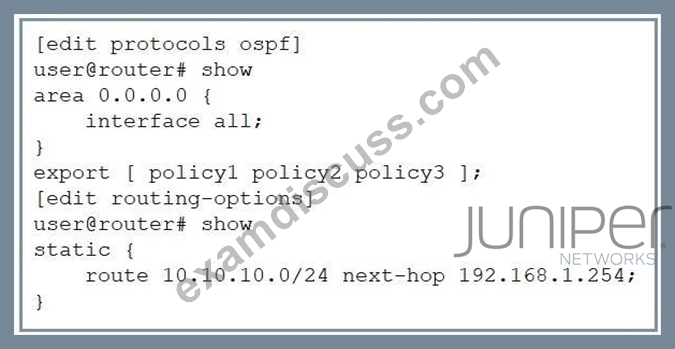
Referring to the exhibit, OSPF has three export policies that match different static route prefixes.
The 10.10.10.0/24 static route does not match any terms in the policy1 routing policy. What happens next in this scenario?
- A. The static route is evaluated by the policy3 routing policy.
- B. The static route is evaluated by the policy2 routing policy.
- C. The static route is rejected by the policy1 routing policy.
- D. The static route is rejected by the default routing policy.
Answer: B
NEW QUESTION # 182
Which statement is correct when Router R1 receives a packet from User A destined for User B as shown in the exhibit?
- A. Router R1 replaces the destination MAC address in the packet with the MAC address of User B.
- B. Router R1 leaves the packet unchanged.
- C. Router R1 replaces the destination IP address in the packet with the IP address of Router R2.
- D. Router R1 replaces the destination MAC address in the packet with the MAC address of Router R2.
Answer: D
Explanation:
Comprehensive and Detailed 150 to 250 words of Explanation From: In a routed environment like the one shown in the exhibit, traffic forwarding involves a constant interaction between Layer 3 (Network) and Layer
2 (Data Link) addressing. When User A generates a packet destined for User B, the source and destination IP addresses remain static throughout the entire journey across the network (assuming no Network Address Translation is performed). However, the Layer 2 Ethernet headers must be rewritten at every hop because MAC addresses have only local significance on a physical segment.
As Router R1 receives the packet from User A, it performs a lookup in its Forwarding Information Base (FIB) and identifies that the path to User B requires forwarding the packet to Router R2. R1 decapsulates the incoming frame, stripping away the original Ethernet header that contained User A ' s source MAC and R1 ' s own destination MAC. To forward the packet to the next hop, R1 creates a new Ethernet header. The source MAC address becomes the MAC address of R1's egress interface, and the destination MAC address is replaced with the MAC address of Router R2 . R1 cannot use User B ' s MAC address at this point because User B is not on a directly connected segment. This hop-by-hop MAC address replacement is essential for the Packet Forwarding Engine to successfully deliver the frame to the next Layer 3 device in the path. Reference:
Networking Fundamentals, Packet Forwarding, Layer 2 and Layer 3 Addressing.
NEW QUESTION # 183
Which two statements are true about the PFE? (Choose two.)
- A. The PFE is responsible for performing protocol updates and system management.
- B. The PFE handles all processes that control the chassis components.
- C. The PFE uses Layer 2 and Layer 3 forwarding tables to forward traffic toward its destination.
- D. The PFE implements various services such as policing, stateless firewall filtering, and class of service.
Answer: C,D
Explanation:
The Packet Forwarding Engine (PFE) in Juniper Networks devices is the heart of the data plane, handling the actual forwarding of packets based on pre-computed forwarding tables. It provides several critical services to manage and control traffic flow, including policing (to enforce bandwidth limits for certain traffic types), stateless firewall filtering (to permit or deny traffic based on predefined criteria), and Class of Service (CoS) (to prioritize traffic to ensure quality of service for critical applications). The PFE utilizes both Layer 2 (MAC addresses) and Layer 3 (IP addresses) forwarding tables to make intelligent forwarding decisions, ensuring that packets are efficiently routed toward their final destination.
NEW QUESTION # 184
You are trying to diagnose packet loss at interface ge-0/0/3. In this scenario, which command would help you view error statistics in real time?
- A. show interface terse
- B. monitor interface traffic
- C. monitor interface ge-0/0/3
- D. show interface ge-0/0/3
Answer: C
Explanation:
The monitor interface ge-0/0/3 command is used in Junos OS to view real-time statistics for a specific interface. This command helps in diagnosing issues like packet loss by displaying real- time updates of traffic and error statistics for the specified interface.
NEW QUESTION # 185
You asked a network engineer to configure a new logical interface on a Juniper router. The interface must use the fourth usable host address from the 172.16.40.128/29 subnet. Which IP address is correct in this scenario?
- A. 172.16.40.135
- B. 172.16.40.130
- C. 172.16.40.131
- D. 172.16.40.132
Answer: D
Explanation:
In the Junos OS environment, precise IP addressing and subnet calculation are foundational for interface configuration. A /29 subnet mask (255.255.255.248) provides a total of 8 IP addresses. To identify the usable host range, we must first identify the network and broadcast addresses. For the subnet 172.16.40.128/29, the network address is 172.16.40.128. The broadcast address is the last address in the block, which is
172.16.40.135.
Following standard IPv4 conventions, the first and last addresses in a block are reserved for the network identity and the directed broadcast, respectively. This leaves 6 usable host addresses: 172.16.40.129 through
172.16.40.134. Counting sequentially from the beginning of the usable range: the first usable host is .129, the second is .130, the third is .131, and the fourth usable host is 172.16.40.132. Assigning this specific address ensures that the Packet Forwarding Engine can correctly route traffic within the intended segment. As a Senior Architect, it is critical to verify these boundaries when using the set interfaces unit 0 family inet address command to prevent address overlapping or the accidental assignment of reserved network/broadcast IDs.
Reference: Networking Fundamentals, IPv4 Addressing, CIDR Subnetting.
NEW QUESTION # 186
......
As we all know, there are many reasons for the failure of the JN0-106 exam, such as chance, the degree of knowledge you master. Although the JN0-106 exam is an exam to test your mastery of the knowledge of JN0-106, but there are so many factor to influence the result. As long as you choose our JN0-106 exam materials, you never have to worry about this problem. Because we will provide you a chance to replace other exam question bank if you didn’t pass the JN0-106 Exam at once. What’s more important it’s that also free of charge only if you provide relevant proof. It is very convenient to replace and it's not complicated at all. It will not cause you any trouble.
JN0-106 Online Tests: https://www.examdiscuss.com/Juniper/exam/JN0-106/
- Latest JN0-106 Test Practice ❎ New JN0-106 Exam Duration ???? JN0-106 Mock Exam ???? Search for 「 JN0-106 」 and obtain a free download on ➥ www.vce4dumps.com ???? ????JN0-106 New Dumps Free
- Excellent Juniper Test JN0-106 Practice - JN0-106 Free Download ???? Simply search for ▛ JN0-106 ▟ for free download on ➥ www.pdfvce.com ???? ????Test JN0-106 Dumps Demo
- Latest JN0-106 Test Practice ???? Reliable JN0-106 Exam Registration ???? JN0-106 Reliable Dumps Questions ???? Enter 《 www.pass4test.com 》 and search for ➠ JN0-106 ???? to download for free ⬜JN0-106 Guaranteed Passing
- 100% Pass Juniper - Authoritative Test JN0-106 Practice ???? Download ( JN0-106 ) for free by simply entering 《 www.pdfvce.com 》 website ????Latest JN0-106 Test Practice
- Trustable Test JN0-106 Practice | 100% Free JN0-106 Online Tests ⏳ The page for free download of ▶ JN0-106 ◀ on ⮆ www.exam4labs.com ⮄ will open immediately ????JN0-106 Exam Objectives
- New JN0-106 Cram Materials ???? Reliable JN0-106 Exam Registration ???? Practice JN0-106 Exam Pdf ???? Download “ JN0-106 ” for free by simply entering ✔ www.pdfvce.com ️✔️ website ????New JN0-106 Cram Materials
- JN0-106 Exam copyright - JN0-106 Test Quiz - JN0-106 Practice Material ???? Search for “ JN0-106 ” and easily obtain a free download on 「 www.examcollectionpass.com 」 ????JN0-106 New Guide Files
- Practice JN0-106 Exam Pdf ♣ JN0-106 Guaranteed Passing ???? JN0-106 Valid Vce Dumps ???? Simply search for ▷ JN0-106 ◁ for free download on { www.pdfvce.com } ????Reliable JN0-106 Exam Registration
- JN0-106 Downloadable PDF ???? JN0-106 Certification ???? Test JN0-106 Free ???? Open 「 www.vce4dumps.com 」 enter ➽ JN0-106 ???? and obtain a free download ????New JN0-106 Exam Duration
- Free PDF Juniper - JN0-106 - Junos, Associate (JNCIA-Junos) –High-quality Test Practice ???? Easily obtain ▷ JN0-106 ◁ for free download through ⮆ www.pdfvce.com ⮄ ????Reliable JN0-106 Exam Registration
- Pass Guaranteed 2026 JN0-106: Junos, Associate (JNCIA-Junos) Updated Test Practice ???? Search for ➡ JN0-106 ️⬅️ and easily obtain a free download on [ www.troytecdumps.com ] ????JN0-106 Valid Vce Dumps
- ticketsbookmarks.com, sociallytraffic.com, pennypqkl472675.blogspothub.com, hamzazelc313707.ourabilitywiki.com, susanmmoc200298.angelinsblog.com, lewisylpw005821.life3dblog.com, carlyrzov997970.bloggerchest.com, checkbookmarks.com, jayacnxp832968.ssnblog.com, jayahlxd358483.blogcudinti.com, Disposable vapes
BTW, DOWNLOAD part of ExamDiscuss JN0-106 dumps from Cloud Storage: https://drive.google.com/open?id=1l91z90ZFFo105sQYE85D01HiJ2YhgP0J
Report this wiki page